Jose Canseco Baseball Cards - Defining the Timeline Framework and Eras
 mouschi
Posts: 734 ✭✭✭✭
mouschi
Posts: 734 ✭✭✭✭
I know this won't 100% track with most of you here, but hopefully it'll help you to define the different collecting eras of your favorite player(s)!
A Production-Driven Framework for Career, Legacy, and Modern Collecting

Jose Canseco’s baseball card timeline is unlike many other stars of his generation. His cardboard presence didn’t simply rise and fall with his playing career—it surged, fragmented, disappeared, and then re-emerged in a completely different hobby ecosystem. Because of that, lumping all Canseco cards into one pile misses what actually happened.
This framework breaks Canseco’s card history into clearly defined eras based on production behavior, not nostalgia or arbitrary dates. Each era reflects how the hobby viewed him at the time—and how collectors should think about the cards today.

Career Era (1986-2002)
- Junk Wax Era (1986-1992)
- Competition Driven Insert & Parallel Craze (1993-1999)
- Birth of Pack-Pulled Autographs & Relics (2000-2002)
Legacy Era (2002-2005)
Silent Era (2006-2013)
Post-Career Modern Era (2014-Present)
Career Era (1986–2002)
Active player cards and immediate retirement overlap
The Career Era covers Canseco’s entire time as an active major leaguer, plus the immediate spillover that followed his final seasons. While his last MLB game came in 2001, 2002 still functioned as career-adjacent in terms of card production, using recent photography (most of the time, anyway,) contemporary product lines, and active-player framing.
This era is best understood as three distinct sub-eras, with overlap.
Career Era // Junk Wax Era (1986–1992)
Volume without scarcity

This is the period that introduced Canseco to the hobby—and overwhelmed it.
Key characteristics:
-
Massive print runs
-
Minimal inserts
-
Little to no serial numbering
-
Canseco positioned as a centerpiece superstar
Why it matters: While scarcity is low, this era contains some of Canseco’s most culturally important cards. These are the cards that defined his image as baseball’s first true power phenomenon. Condition sensitivity, not rarity, is the primary driver of value.
Caveat:
In spite of the fact that 99% of the cards from this era do not hold a tremendous amount of value, there are some true gems with legendary status, full stop. Lower on the scale, the legendary Donruss Elite and Topps Desert Shield. To get into the higher end, such as the 1986 Donruss White Letter, 1988 Topps Cloth, 1989 Donruss/Leaf Blue Chips and 1990 Donruss Aqueous, you are firmly in grail territory.
Career Era // Competition-Driven Insert & Parallel Craze (1993–1999)
Scarcity enters the picture
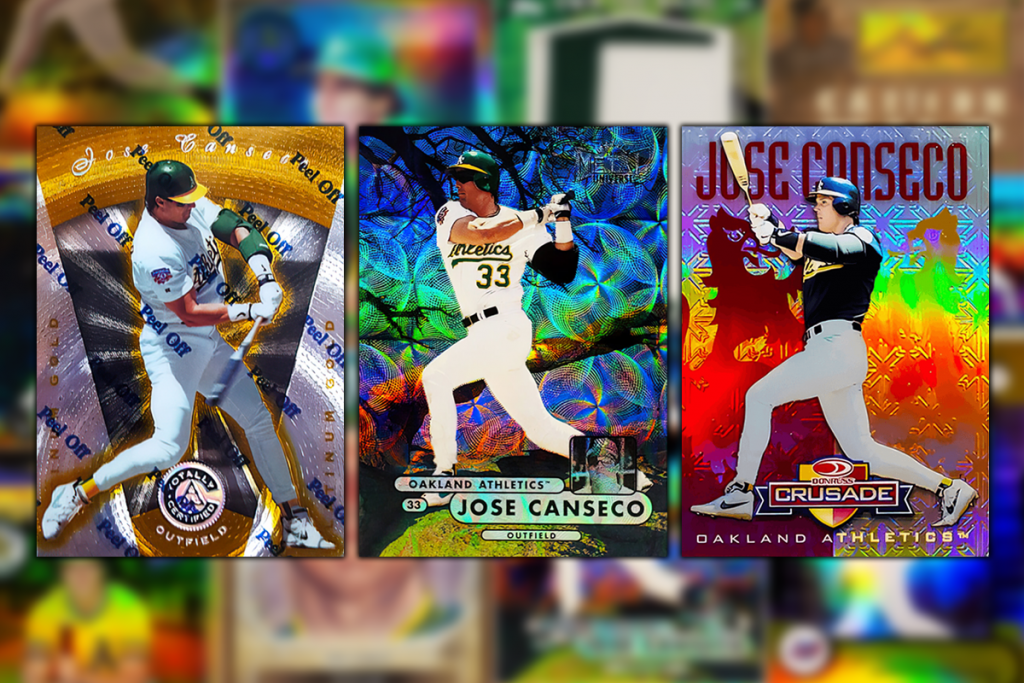
By the early/mid 1990s, the hobby began correcting itself. Inserts, odds-based pulls, early serial numbering, and premium brands emerged—and Canseco remained a frequent inclusion. While there is some overlap, this part of the timeline is marked with some of the most coveted cards on the planet - largely without the assistance of relics or autographs. Flash, creativity and scarcity put this time period on the map.
Key characteristics:
-
Insert-driven chase cards
-
Transition toward premium products
-
Canseco still treated as a major draw
Why it matters: This is beginning of premium treatment, and arguably this period in the timeline does it the best. Many of Canseco's most important cards ever produced live in this time period. From 1996 Select Certified Mirror Gold, 1997 Pinnacle Totally Certified Platinum, 1998 Donruss Crusade Red, Essential Credentials, 1998 PMG, 1999 Fleer Brilliants 24k all are Mount Rushmore worthy - a true grail field, and have keep collectors up at night for decades trying to capture them.
Caveat:
There is overlap between this era and the next. The very first pack-pulled autograph was inserted in 1999 packs.
Career Era // Birth of Pack-Pulled Autographs & Relics (1999-2002)
Certified autographs and relic cards make an appearance
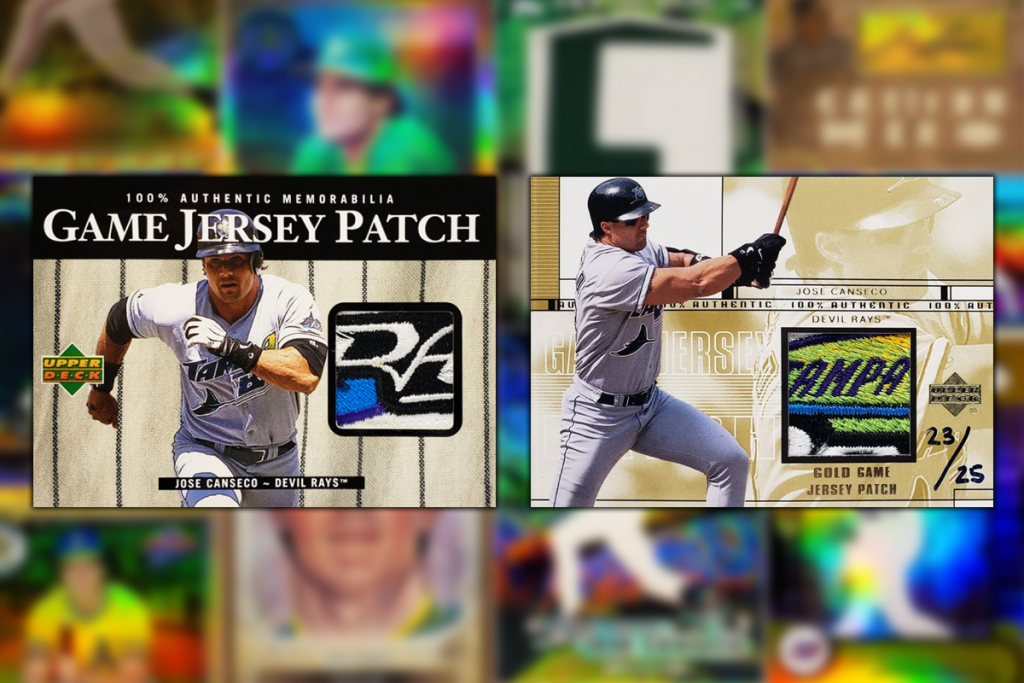
Beginning in 1999, card manufacturers moved beyond simply producing visually appealing cards and began introducing pack-pulled autographs and genuine game-worn or game-used relics. While these features may feel commonplace today, their arrival marked a fundamental shift in the hobby.
For Jose Canseco, this era is especially significant. His first-ever pack-pulled autographs, early relics, autograph-relic combinations, and patch cards all originate here. These were not retrospective creations or nostalgia pieces—they were produced while he was still an active player, making them the only examples of their kind from his true career era.
Firsts matter, and so do early versions, thus a premium should be placed upon them. These cards represent the moment when the hobby changed—and Canseco was part of that change in real time. They aren’t just early chase cards; they are the foundation upon which everything that followed was built.
Key characteristics:
-
Introduction of first ever game-used/worn & autographed cards
-
Inserts & Parallels are still an incredibly strong draw
-
The last few years of Canseco's playing career, making these the only career-era pack-pulled autographs and memorabilia cards.
Why it matters: Understanding this era is essential because many of Jose Canseco’s most important “firsts” reside here—his earliest pack-pulled autographs and the introduction of genuine game-used cards. While modern autograph and relic cards can sometimes feel routine or even gimmicky, career-era examples from this period are fundamentally different. They represent the drastic elevation of the hobby’s chase culture and should be viewed with true grail-level reverence.
Caveat: The distinction between pack-pulled autographs and game-used cards from this era and those produced in the post-career modern era cannot be overstated. There is a meaningful difference between a card that could have been pulled from a pack while Canseco was still actively writing his on-field legacy, and one created years—or decades—after the fact. Cards from this period deserve heightened collecting respect, as they represent moments captured in real time rather than retrospective recreations. Special lightning in a bottle that is impossible to be replicated.
Legacy Era (2002–2005)
Post-career, but still present
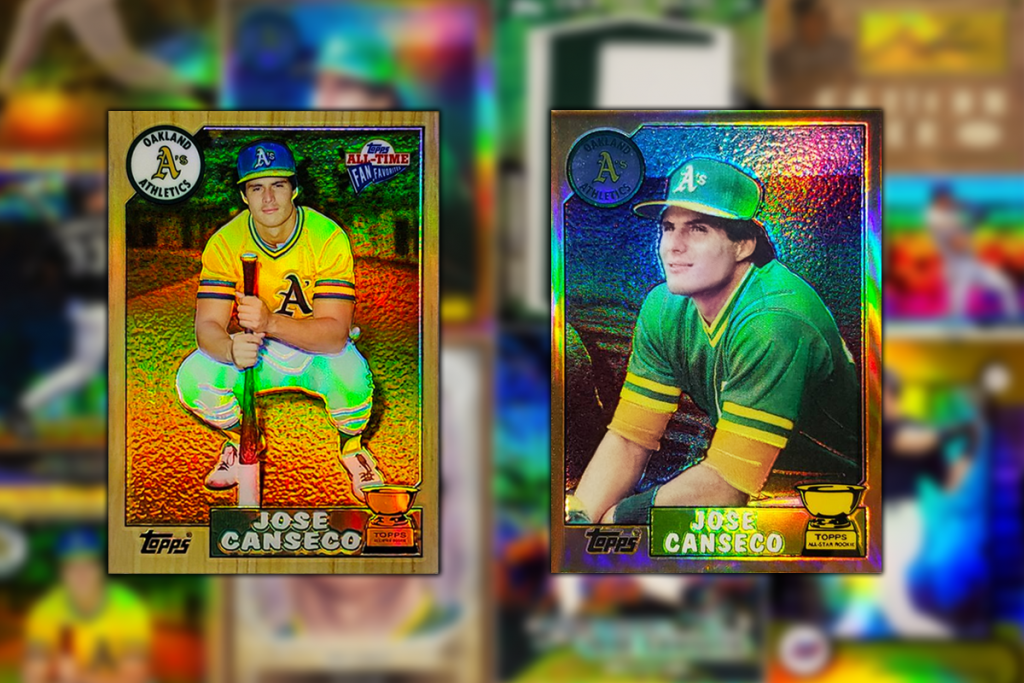
The Legacy Era captures the years immediately after Canseco’s retirement when card manufacturers were still producing him regularly. He was no longer active, but he remained close enough to the game—and the hobby—to justify continued inclusion.
Key characteristics:
-
Regular appearances across mainstream products
-
Contemporary card design and photography
-
Continuation of amazing memorabilia, parallel, insert, and autograph cards
Why it matters: This is the hobby processing Canseco’s career in real time. Cards from this era often feel like natural extensions of his playing days, rather than historical tributes. In fact, no two eras are as close to each other as the career and legacy eras are.
Caveat:
Though both the Legacy and Post-Career Modern eras are technically all beyond career-era territory, they should be seen as completely separate from each other. The Birth of pack-pulled relics & autographs from the Career Era and Legacy Era however, go hand in hand. Important distinctions can be drawn from each other, but they do rhyme.
Silent Era (2006–2013)
Minimal output, minimal attention
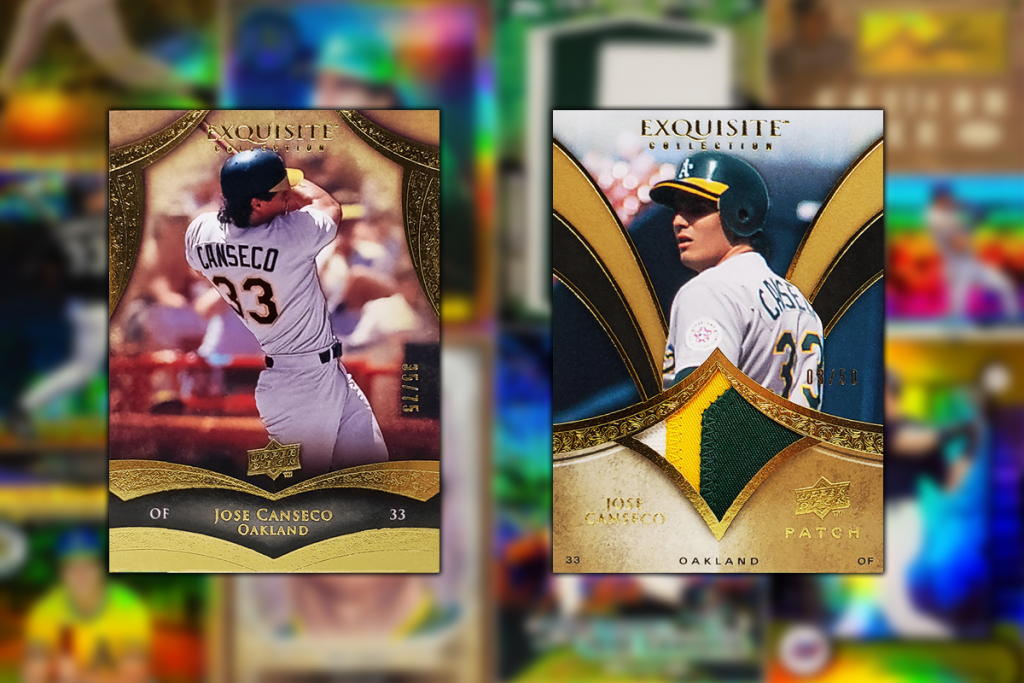
The Silent Era is defined not by style, but by absence. From 2006 through 2013, meaningful new Canseco cards became sparse. In many years, he appeared in only one or two true “card types,” often in niche products or limited releases.
Key characteristics:
-
Extremely low number of distinct card types
-
Sporadic appearances
-
Little hobby focus or narrative framing
Why it matters: This period creates a clean production gap. It explains why the later explosion feels so dramatic—and why cards from this window often feel disconnected from both his career and his modern legacy.
Caveat:
A handful of unlicensed or specialty cards appear near the end of this era, but they do not represent sustained production. Still, one card type shines as one of the few exceptions: 2010 Exquisite. The ultra limited set features, a base card, a dual patch card he shares with Eckersley, a triple patch card he shares with Mattingly & Bo Jackson, and my absolute favorite: a single patch card that is his own. These are all incredibly valuable, and extremely limited (in spite of the serial numbers, only low-mid single digits exist of each.) True stand-out grails of the Silent Era.
Why the Silent Era Happened
Jose Canseco’s near-absence from baseball cards between 2006 and 2013 was not accidental. It was the result of timing, industry contraction, and risk aversion converging at once.
In early 2005, Canseco released Juiced, a book that placed him at the center of baseball’s steroid reckoning. As Major League Baseball entered a period of public scrutiny and image management, Canseco became closely associated with the sport’s most uncomfortable narrative. That mattered—not because he was legally unlicensable, but because card companies were making increasingly conservative checklist decisions.
At the same time, the trading card industry itself was shrinking. Beginning in 2006, the number of licensed manufacturers and total products dropped sharply. With fewer sets and less checklist space, companies prioritized active stars, rookies, and universally “safe” legends. Retired players without an established nostalgia framework—or those perceived as polarizing—were often excluded.
The result was the Silent Era: years in which Canseco appeared only sporadically, often limited to a single card type in a given year, if at all. These were not curated legacy tributes, but isolated appearances, reflecting an industry that had not yet figured out how to reframe his career.
Post-Career Modern Era (2014–Present)
Curated legacy, premium execution
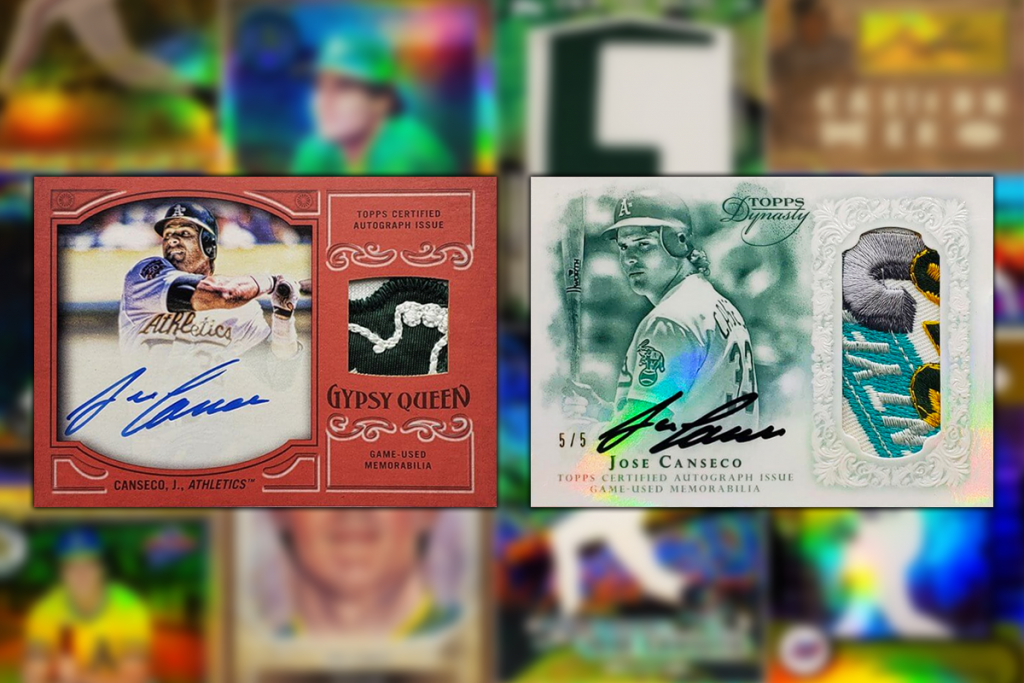
Beginning in 2014, Canseco’s cardboard presence changes completely. Licensed products return him to regular production, this time framed explicitly as a legacy figure rather than an active or recently retired player.
Key characteristics:
-
High volume of licensed cards
-
Heavy focus on autographs, patches, booklets, premium relics, and low serial numbers
-
Concept-driven inserts and curated storytelling
-
Sustained, ongoing production
Why it matters: This is where Canseco becomes a modern collectible. Scarcity is intentional, design is deliberate, and his career is actively curated for a new generation of collectors.
Caveat:
Not all modern cards are equal. Volume is high, so significance should be judged by design intent, rarity, and placement within a product—not simply by year. While previous eras give at least the illusion that you can "have it all" (1/1s notwithstanding) the Post-Career Modern Era blasts that possibility away. It is the perfect era to be treated as a buffet - collect what you like, and don't worry about the rest. That said, many of Jose's most significant cards were created in this time period.
Why This Framework Matters
Defining Canseco’s card history by production behavior rather than sentiment allows collectors to:
-
Set clear collecting goals
-
Identify meaningful cards versus filler
-
Understand why certain cards feel more important than others
-
Avoid forcing modern logic onto junk-wax realities—or vice versa
Jose Canseco didn’t just have a career. He had multiple cardboard lives, each shaped by a different version of the hobby itself. Naming those eras isn’t just semantics—it’s how we make sense of one of the most complex legacies in baseball card history.
Comments
@mouschi Great and informative post as always. I have hopefully a simple question: Which card is most recognized as Canseco's true rookie card? There are so many from 1986. Personally, I have always considered 86 Donruss as his true rookie card, but I'm sure that a case can be made for the 86 Fleer (sharing the card with Eric Plunk) or 86 Topps Traded (another solo card).
I have to give alot of credit to the STAR company for creating an entire subset of cards and stickers for Jose in 1986!
collecting O-Pee-Chee (OPC) baseball cards
also collecting US & Canadian junk silver
Thank you brother! His very first licensed MLB card was the Rated Rookie. It will always be his most iconic card. I'd say his second most iconic is his 1987 Topps rookie cup card. Interesting note: buybacks notwithstanding, the Rated Rookie has been reprinted exactly one time, in 2001 just before he retired. Donruss made a /1986 version and an /86 holographic foil parallel. The 87 Topps rookie cup number of reprints? Dozens upon dozens of times!
Interesting piece Tanner - and an excellent perspective. As usual a lot of thought went into this; way more than I have in my head as a POV on our hobby.
Thanx buddy!
PS: there's a segment on Canseco in SCD - if you don't have? I'll scan and email you
Nice insight. But I am curious, and perhaps I am offering a a suggesiton, why not take into consideration his minor league cards? Either bifurcated separately as "Pre-MLB career" or just included as part of his "career" era. As you included "post-career", it just seems appropriate to include the few pre-MLB cards he has too. For example, I would definitely put the Donn Jennings minor league cards in the junk wax category, but the 1983 Fritsch although plentiful, isn't Junk Wax production numbers. Cheers!
Thank you very much! i've wanted to flesh this out for quite some time - it was just a matter of carving out time to actually do it. I'd love to see the SCD if you wouldn't mind snapping a pic if it isn't too much trouble!
It is very good thinking! I considered it, but decided against it so as to keep it major league baseball related. He only has 4 cards total in terms of minor league cards. I was considering independent league cards (post career) but figured that'd muddy the waters further. Who knows though? I may update it later to add one or both
Here ya go Tanner - not very long.
thank you so much brother!