Papal Medal - Leo X / Shepherd Seated with His Flock
 Iosephus
Posts: 872 ✭✭✭
Iosephus
Posts: 872 ✭✭✭
Pope Leo X, c. 1513
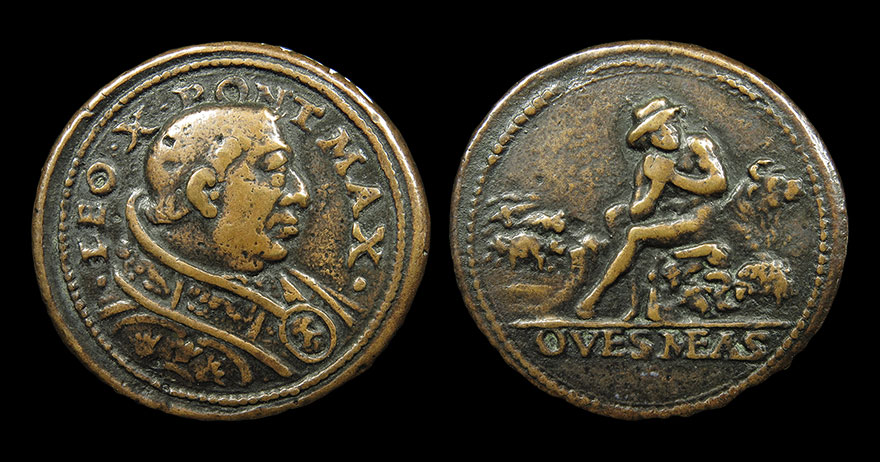
Bronze, 32.6 mm Ø, 18.9 g
Obverse: Bust of Leo X facing right, bare headed, wearing decorative cope. Around, · LEO · X · PONT MAX · (Leo X, Supreme Pontiff).
Reverse: A shepherd, naked and seated on a rock, wearing a hat. To the left, his flock of sheep. In exergue, OVES MEAS (My Sheep).
An interesting little medal, likely created to celebrate Leo X's election to the pontificate. The reverse of the cast medal features a reverse design taken from a struck medal of Julius II by Pier Maria Serbaldi; the obverse has no known prototype. On the medal of Julius II, the reverse design features the inscription TVTELA (Protection) instead of OVES MEAS .
The reverse inscription would seem as a reference to the Gospel of St. John 21:17, Dicit ei tertio: Simon Joannis, amas me? Contristatus est Petrus, quia dixit ei tertio: Amas me? et dixit ei: Domine, tu omnia nosti, tu scis quia amo te. Dixit ei: Pasce oves meas. (He said to him the third time: Simon, son of John, lovest thou me? Peter was grieved, because he had said to him the third time: Lovest thou me? And he said to him: Lord, thou knowest all things: thou knowest that I love thee. He said to him: Feed my sheep.) In this way, the medal can be tied to the election of Leo X as the successor of St. Peter.
Leo X was born in Florence in 1475 as Giovanni de' Medici, the second son of Lorenzo the Magnificent and Clarice Orsini. Exiled in 1494 with his family, he wandered in France, Holland, and Germany before returning to Rome in 1500. He was made protonotary apostolic at the age of only seven, and was made a cardinal in 1489 by Innocent VIII. He was elected pope on March 9, 1513. The last non-priest to be elected to the papacy, he was ordained as a priest on March 15 and consecrated as bishop on March 17. He was crowned Pope on March 19 in St Peter's Basilica, and took possession of the Lateran on April 11. Leo X died on December 1, 1521.
Due to the extreme rarity of this medal, the use of a reverse taken from another artist, and the overall rather poor workmanship, Modesti suggests it to be a handmade piece with little patron support. Hill, Modesti, and Toderi & Vannel all cite only the Bargello specimen in Florence; Modesti assigns it the highest rarity rating of RRRR.
References: Hill (Corpus) n. 229 note; Modesti (CNORP) n. 229; Toderi & Vannel (XVI Secolo) n. 2481; Vannel & Toderi (Bargello) n. 1343
Comments
That is truly an interesting bit of history.
You do excellent research and imaging. Excellent.
TalerUniverse.com is a curated numismatic project dedicated to the silver talers, crowns, and medals of the Habsburg Empire and the Holy Roman Empire, spanning the 16th–18th centuries. The collection emphasizes historically significant issues, rare mint varieties, and high-grade NGC/PCGS examples, presented with detailed historical context, scholarly references, and high-resolution photography. TalerUniverse aims to serve both as a private collection showcase and a growing reference resource for collectors, researchers, and students of early-modern European coinage.
Wow. That is such a cool acquisition. Congrats!
How does one get a hater to stop hating?
I can be reached at evillageprowler@gmail.com
Fascinating comments about the handmade workmanship. The reverse is quite intriguing.