Options
Contemporary (?) counterfeits of So-Called Dollars
 jonathanb
Posts: 4,111 ✭✭✭✭✭
jonathanb
Posts: 4,111 ✭✭✭✭✭
Here's a collecting challenge -- counterfeits of So-Called Dollars.
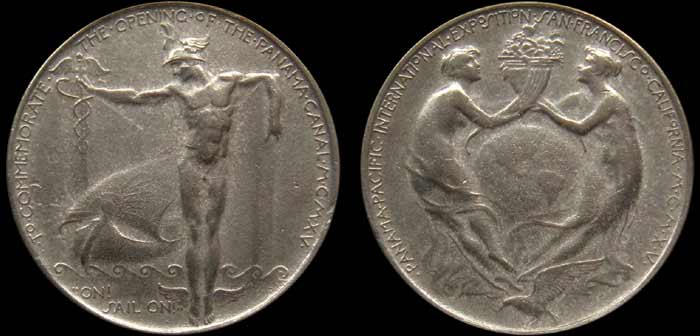
Thsee three are from my big pile of exposition stuff. I was pretty sure that I recognized them before buying, and again I was wrong. These claim to be the Official Medal of the Panama-Pacific International Exhibition (San Francisco, 1915), in silver (HK-399) bronze (HK-400), and gilt (HK-401). The thing is, the first one looks wrong and in hand it feels greasy. I think it's not silver at all, but some sort of cast counterfeit. It weighs about 18 grams. Does anyone with a real one have a weight for their piece? This isn't a terribly common piece, but it's not all that rare either. Until I saw this one, it never occurred to me that someone would counterfeit it.
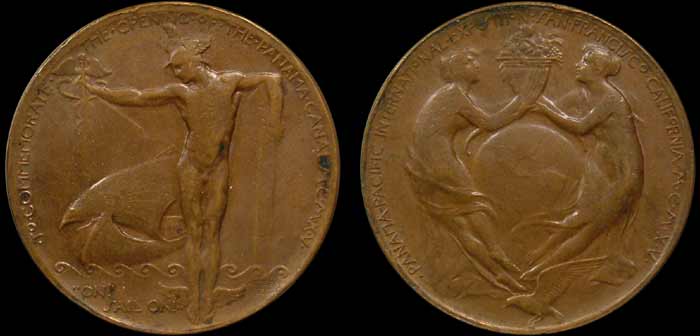
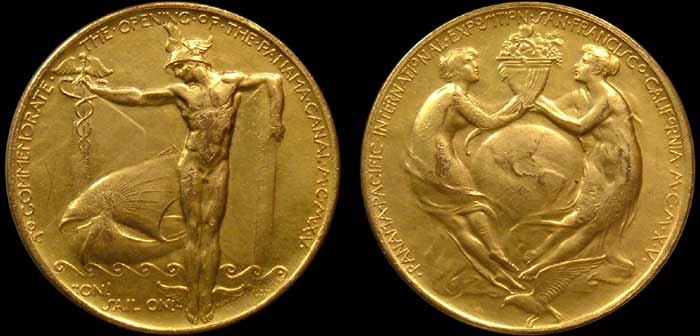
To continue a different thread from a week or two ago, the second image is also an excellent example of a weak strike. The man's chest area and bent arm lines up more or less opposite to the left woman's chest, so there are two opposing high-relief designs on the obverse and reverse. In the bronze example, both areas are very weakly struck (it's more obvious in the coin than in the images, I'm afraid). You can also see weakness at the rims, particularly from 11:00 to 2:00 on the man's side. This is typical of a weak strike, and isn't wear. There is much more actual wear on the gilt piece (the rub-through on the gilding makes wear even more obvious), but the original strike itself is much stronger.
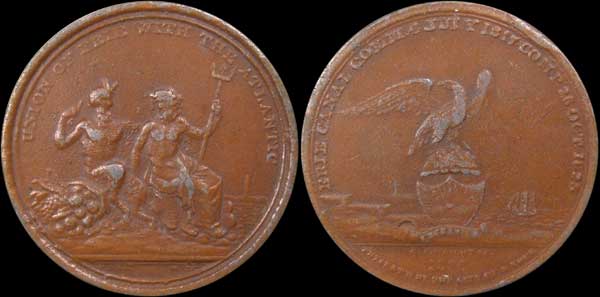
For comparison, here is a petty-definite cast copy of HK-1, probably in lead. For this one, a cast copy doesn't surprise me. It was known to be very rare even in the 19th century. I can't prove it, but I bet that this cast copy was created even before the 1915 expo that was commemorated by the previous three.
Thsee three are from my big pile of exposition stuff. I was pretty sure that I recognized them before buying, and again I was wrong. These claim to be the Official Medal of the Panama-Pacific International Exhibition (San Francisco, 1915), in silver (HK-399) bronze (HK-400), and gilt (HK-401). The thing is, the first one looks wrong and in hand it feels greasy. I think it's not silver at all, but some sort of cast counterfeit. It weighs about 18 grams. Does anyone with a real one have a weight for their piece? This isn't a terribly common piece, but it's not all that rare either. Until I saw this one, it never occurred to me that someone would counterfeit it.
To continue a different thread from a week or two ago, the second image is also an excellent example of a weak strike. The man's chest area and bent arm lines up more or less opposite to the left woman's chest, so there are two opposing high-relief designs on the obverse and reverse. In the bronze example, both areas are very weakly struck (it's more obvious in the coin than in the images, I'm afraid). You can also see weakness at the rims, particularly from 11:00 to 2:00 on the man's side. This is typical of a weak strike, and isn't wear. There is much more actual wear on the gilt piece (the rub-through on the gilding makes wear even more obvious), but the original strike itself is much stronger.
For comparison, here is a petty-definite cast copy of HK-1, probably in lead. For this one, a cast copy doesn't surprise me. It was known to be very rare even in the 19th century. I can't prove it, but I bet that this cast copy was created even before the 1915 expo that was commemorated by the previous three.
0
Comments
jonathan
- Marcus Tullius Cicero, 106-43 BC
It kinda looks like it might be a spark-erosion type, and if there aren't holes and it doesn't weigh to tolerance...well..