How many die pairs are required to strike 500 gold medals?
 cardinal
Posts: 2,005 ✭✭✭✭✭
In the Year 2000, the Paris Mint struck 500 "restrikes" of the Libertas Americana medal. These were made at a diameter very close to the original Libertas Americana medals struck in 1783, and are generally of very high quality. In the Year 2004, the Paris Mint struck 1776 restrikes as well, at a smaller diameter and weight. While the design of both of these issues are extremely similar, they are not identical when compared side by side.
That being said, looking at some examples of the Year 2000 restrikes, I've noticed minor differences as well -- even though only 500 were struck.
Below are some examples of the Year 2000 restrikes, for comparison purposes. All of the photos are TrueViews, but some obviously went through different photo processes than others:
This one is COA #068/500:
This one is COA #207/500: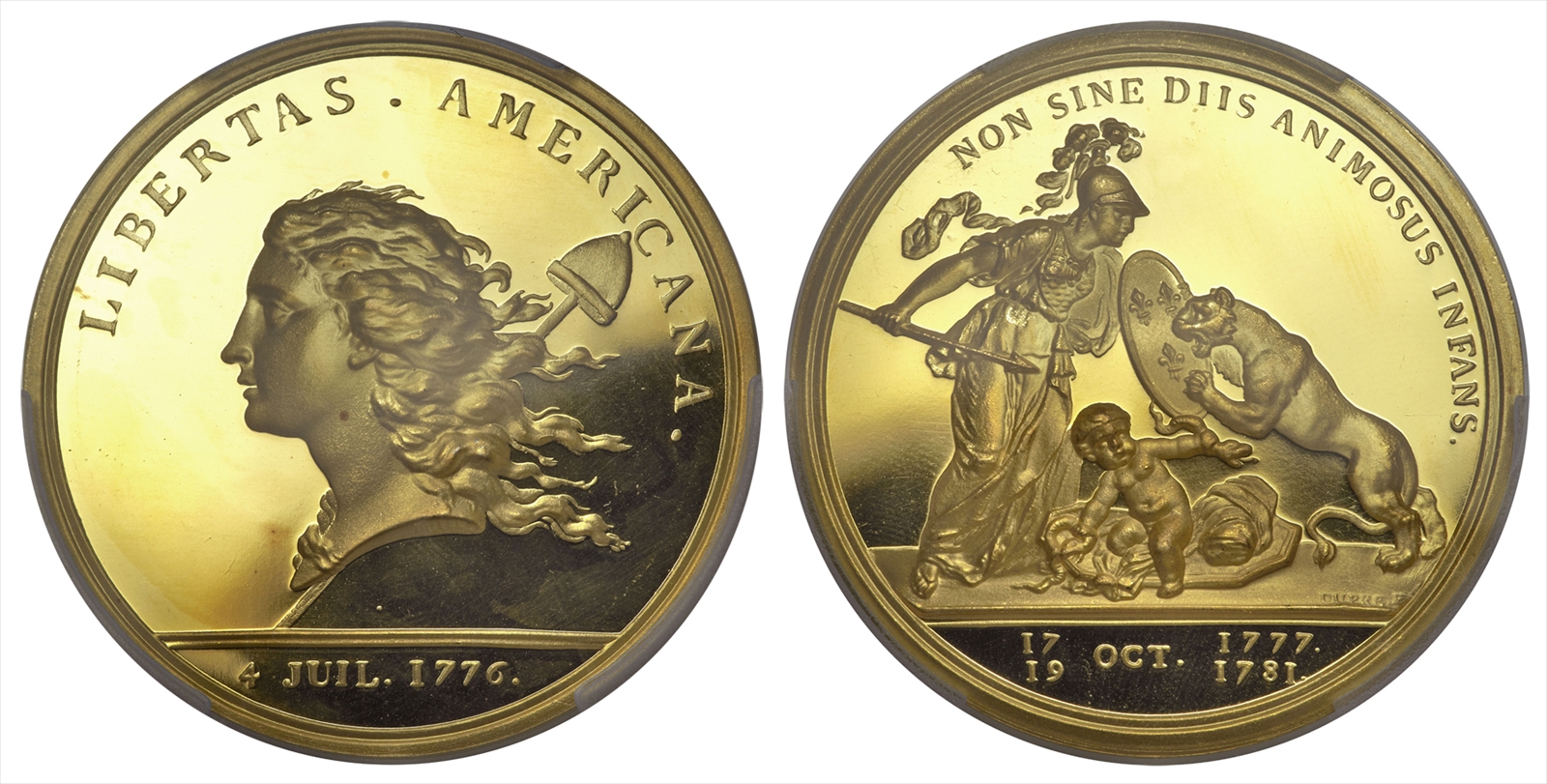
This one is COA #113/500:
This one is COA #143/500:
This one is COA #321/500:
This one is COA #367/500:
This one is COA #384/500:
This one is COA #485/500:
So... how many die pairs does it take to strike 500 gold medals?
Well, comparing all of these side-by-side, it seems to me that 4 separate die pairs were used to strike this 500 piece production, and each pair exhibits early die states and late die states! Who would have guessed the Mint would go to that extreme?
Comments
It's very interesting to see all the different types of TrueViews. Thanks for sharing these.
Looks like some good research can be done on these. I'd love to pick up one of the Year 2000 restrikes.
Given that you know the serial numbers for all of these, do you own them or is it evident on the medal or slab?
Viva la France!
mark
Fellas, leave the tight pants to the ladies. If I can count the coins in your pockets you better use them to call a tailor. Stay thirsty my friends......
Given this is a research thread, I was wondering if we know who Dupré used as a model for Lady Liberty?
That would average out to 125 per die set... do we know if they were actually changed at that point or this is just a chance average? Cheers, RickO
Because this is a luxury project, and since this is France (the home of make-work as an excuse for paying people) perhaps they went to the extreme of four die pairs.
But the fact that this is (relatively soft) gold would also argue against the absolute need to do so, and the fact that this is gold argues against much die deterioration.
I have a very difficult time seeing what you are seeing, in case you want to point out the differences.
I am hardly an expert, but I had a guided tour of 'Les Ateliers de la Monnaie de Paris' in November 1993. They were striking large golden-bronze medals (our kind of medals, not military medals) to be given to veterans of the French Resistance on that day.
Hi @cardinal , would you care to point out or illustrate some of the "die markers" that you are using to identify different die pairs? This could be very educational.
-~-~-~-~-~-~-~-~-~-~-~-~-~-~-~-~-~-~-~-~-~-~-~-~-~-~-~-~-~-~-~-~-~-~-~-~-~-~-~-~-~-~-~-~-~-~-~-~-~-~-~-~-
My sets: [290+ horse coins] :: [France Sowers] :: [Colorful world copper] :: [Beautiful world coins]
-~-~-~-~-~-~-~-~-~-~-~-~-~-~-~-~-~-~-~-~-~-~-~-~-~-~-~-~-~-~-~-~-~-~-~-~-~-~-~-~-~-~-~-~-~-~-~-~-~-~-~-~-
I sorta agree with Bill above, and doubt the NEED for four or more pairs of dies & can see them "creating" more dies - maybe even more out there. I also agree, more power to you Cardinal for picking out the minutiae.
Well, just Love coins, period.
The French have a cult of "French Luxury", a kind of marketing that they try to sell very very hard. La Monnaie de Paris utilizes this kind of marketing on their website and it is reflected in their premium pricing. So I could see more dies than necessary for a project. Sorry if my eyes can't really see the differences.
When the French Mint significantly raised their prices for most medals a few tears back, most of the vendors who already had those items in stock also followed suit. Pricier nowadays.
I happen to own the pictured examples, but I have also been accumulating images of these for several years. Those that have shown up on eBay and major auction houses have had their COA #'s listed in the description, which I took note of when copying the images. So far, I have traced 87 of the 500 pieces struck.
It would be interesting to know how many blows from the dies it takes to strike a gold medal, given that gold is among the malleable of all metals. It took blows to strike the 1989 George H. W. Bush inaugural medal, according this set.
Obviously the more blows it takes to strike medal, the shorter the useful life for each die.
For those who are not familiar with minting techniques, made for circulation coins are almost always struck only once. The big American exception is the 1907 High Relief $20 gold. High relief medals require additional strikes to be bring up the design.
When you look at the first four above, you can see a general softness of Miss Liberty's hair, while the 5th and 6th show more detail, and the 7th and 8th show the sharpest of detail in the hair. All of the medals were fully struck, with no strike weakness at the highest relief points, yet, you can see a difference in the degree of details -- so that must reflect the details of the dies.
Aside from that, there are minor differences in the hair details. It's rather like the situation with early Liberty Cap cents, where the main portrait is stamped into the dies from a common hub, yet the finer hair details were added by hand individually on each die.
Here are close-ups of the hair detail, where you can see those slight differences in the outlines of the hair curls:
Die Pair 1:
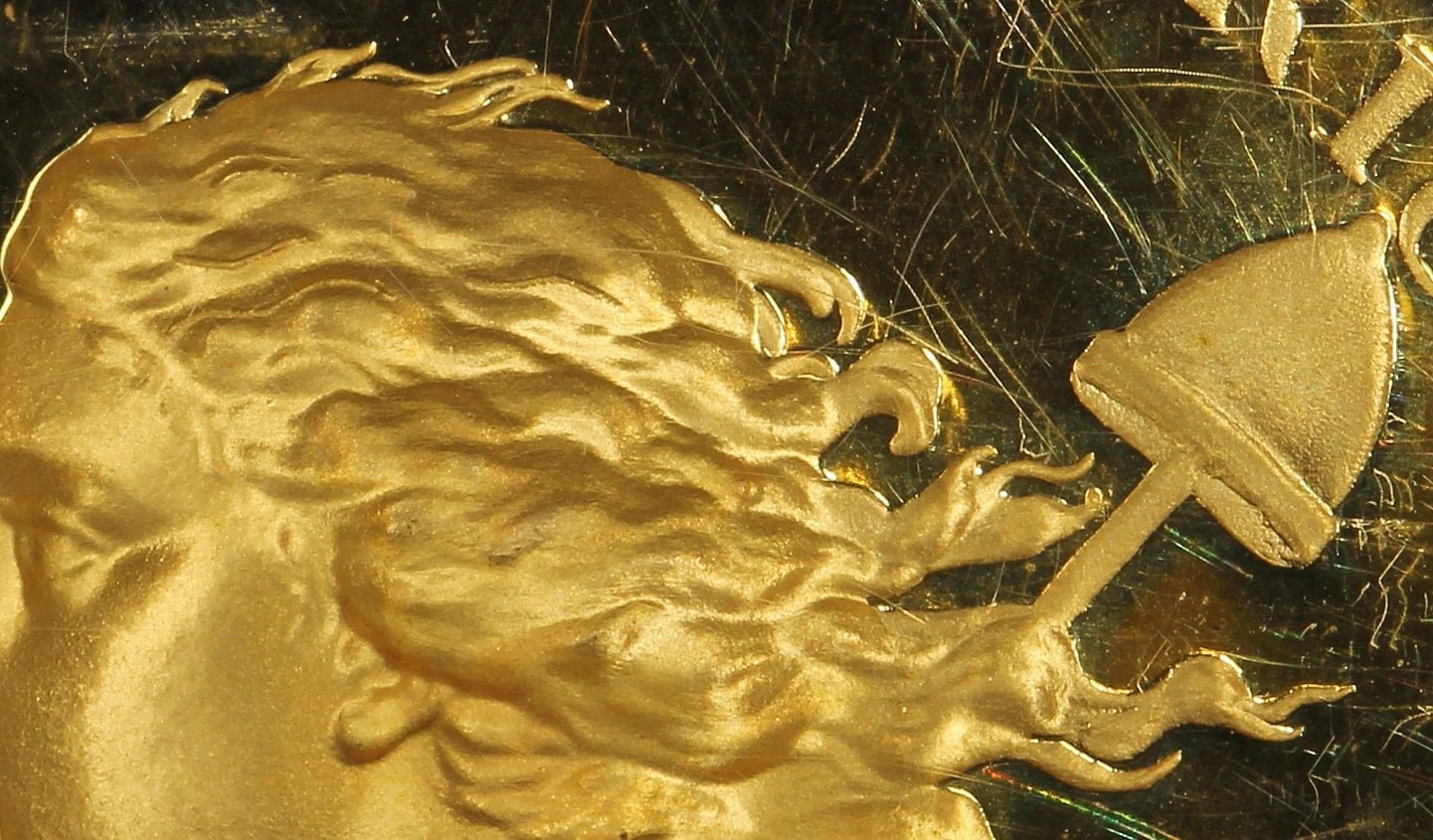
Die Pair 2:
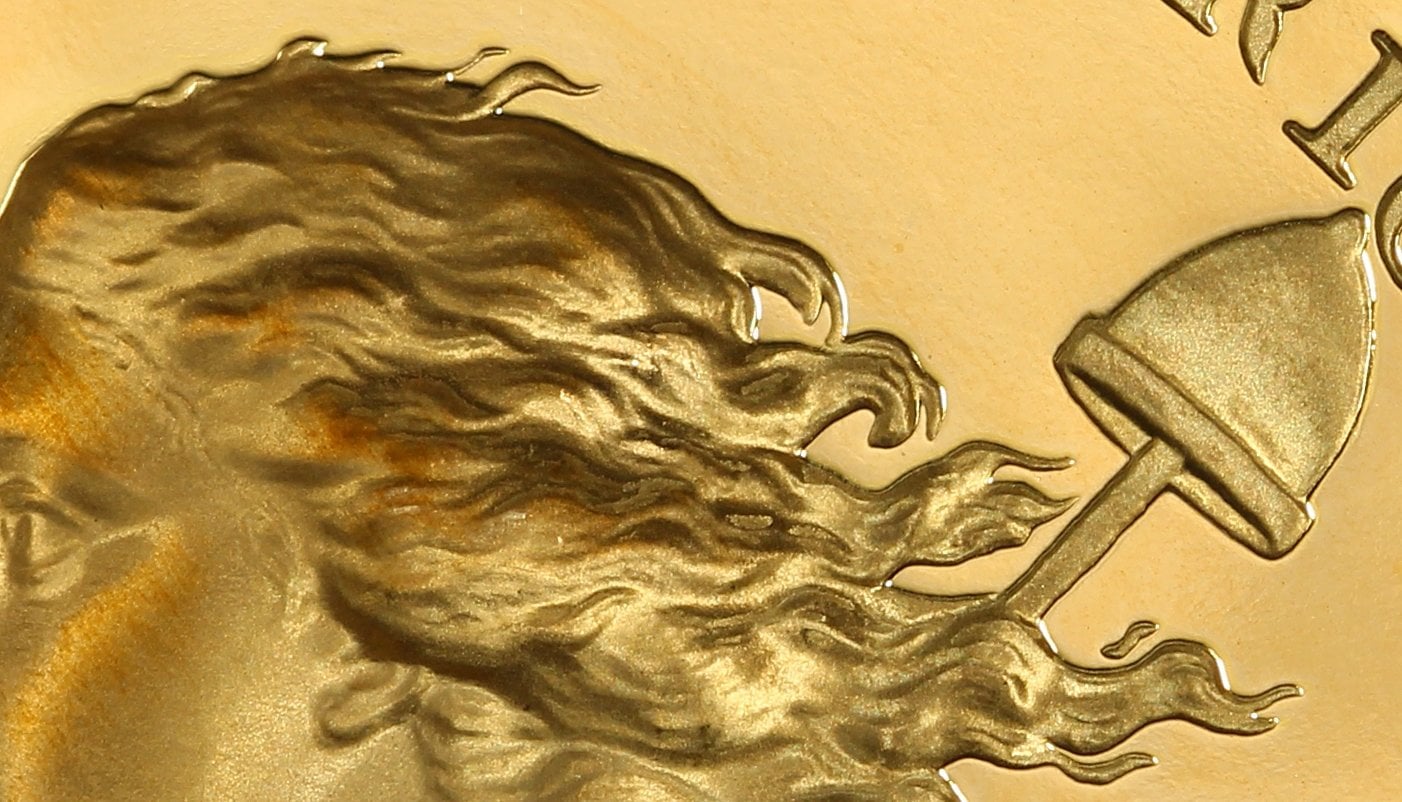
Die Pair 3:
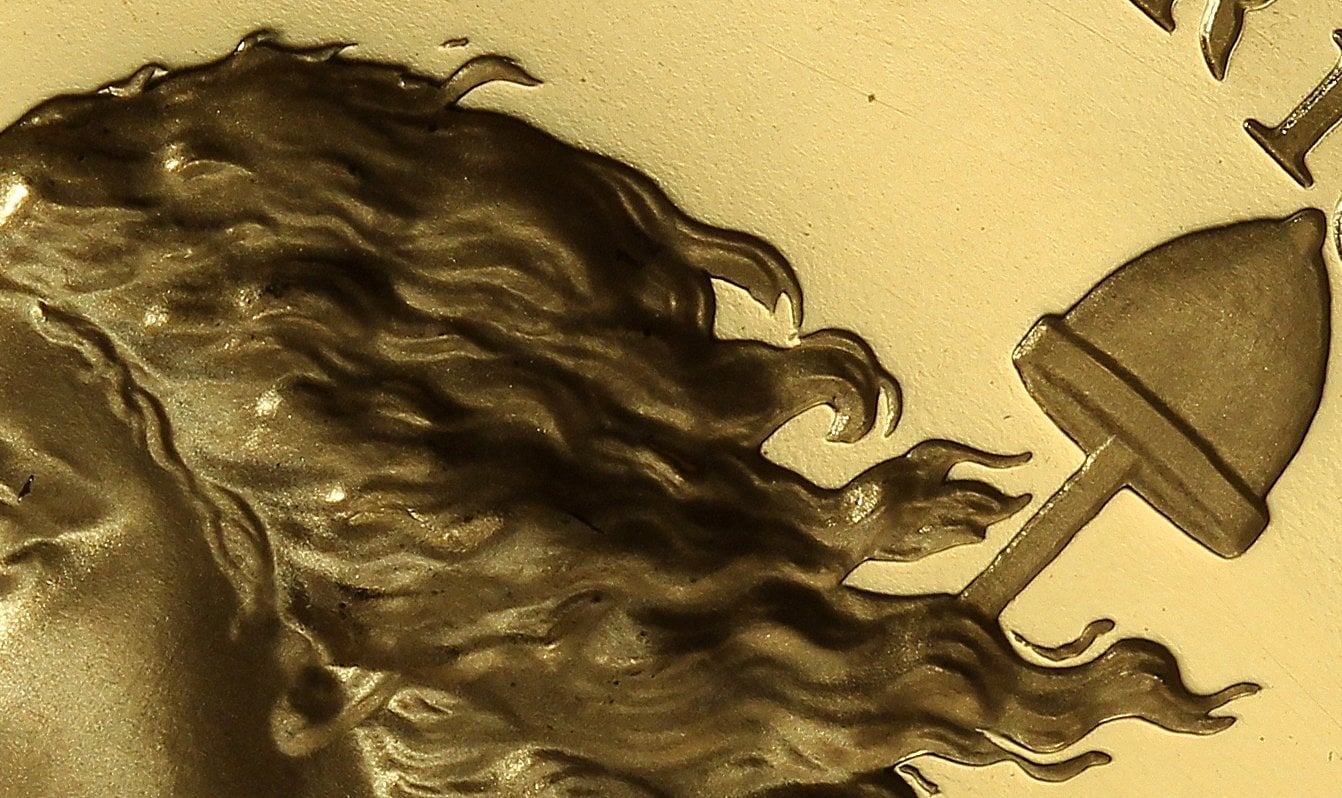
Die Pair 4:
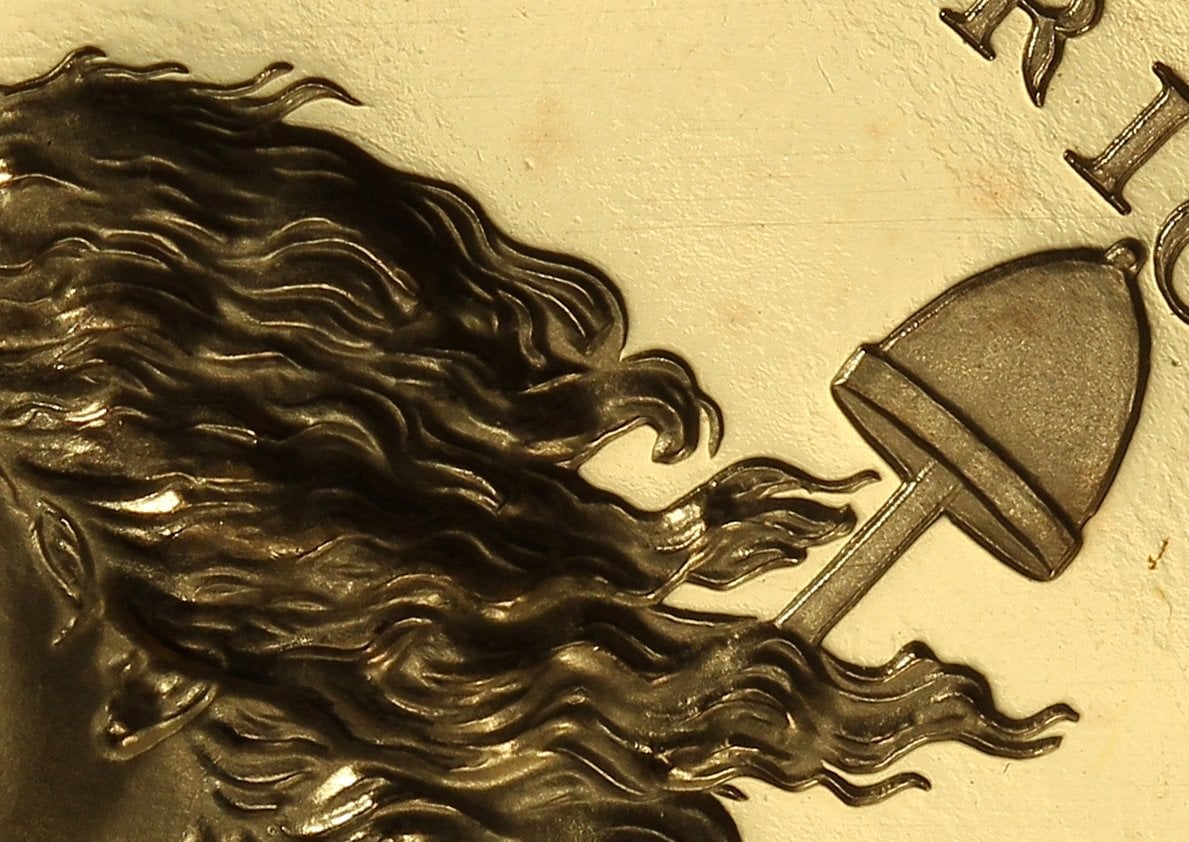
Thanks for the detailed photos, I can see some of that.
I really appreciate the detailed images @cardinal !
-~-~-~-~-~-~-~-~-~-~-~-~-~-~-~-~-~-~-~-~-~-~-~-~-~-~-~-~-~-~-~-~-~-~-~-~-~-~-~-~-~-~-~-~-~-~-~-~-~-~-~-~-
My sets: [290+ horse coins] :: [France Sowers] :: [Colorful world copper] :: [Beautiful world coins]
-~-~-~-~-~-~-~-~-~-~-~-~-~-~-~-~-~-~-~-~-~-~-~-~-~-~-~-~-~-~-~-~-~-~-~-~-~-~-~-~-~-~-~-~-~-~-~-~-~-~-~-~-
During the time of the development of the Libertas Americana medal, U.S. Mint engraver Joseph Wright (who engraved the very first dies for the Liberty Cap cents) was in Paris, and Benjamin Franklin provided his endorsement to be employed by the Mint. Wright's painting of his family includes his wife, who does bear a strong resemblance to the image of Liberty in the Libertas Americana medals. That being said, there appears to be no written record of the identity of the model for the medal.
Here is the Wright Family painting from the Pennsylvania Academy of Fine Arts:
I guess a key question is how many times were each of these fairly sizeable medals struck to bring up all the detail?
Even though only 500 were struck, the die pairs may have delivered 2,000 or more total blows to the planchets.
These probably required extra high tonnage, which could decrease die life.
This is an interesting thread. Those are obviously different die pairs. Since gold is a soft metal I'm guessing they required higher strike pressure for some reason.
The pressure required might be more if the original medals and the year 2000 reproductions were around 45mm (that should be the diameter, methinks), but if we are talking 0.920 fine gold, the gold itself should be easier to strike. Wouldn't that be the correct way to think?
Also, that painting has a tragic story behind it: https://www.pafa.org/collection/wright-family
@cardinal... Thanks for the detailed pictures... the differences become very apparent. It would be interesting to know how many times each was struck... Cheers, RickO
The Original medals struck in 1783 have a diameter of 47.5mm. The Year 2000 Gold restrikes have a similar diameter at 46.8mm.
For further comparisons, the gold restrikes from 2004 are 40mm:
and the ones from 2014 were struck at 50.0mm (5 ounce medals):
and 34.0mm (1 ounce medals):
Apmex had previously offered a gold Libertas Americana that they said was 2001 issued, circa 45 mm and 0.920 gold. I had that instance in the back of my mind, although the description or my recollection might well be faulty.
When I went to find that one again, all I could find was this product, possibly/ probably from 2013: http://www.apmex.com/product/58434/1776-france-proof-gold-tribute-libertas-americana-medal
I think the definitive answer would require closer examination and probably overlays of what you believe to be different dies that were used. I didn't look at them closely, at least not as close as you have, but my first thought is that the differences may simply be the result of re-polishing and preparing the dies for use after a determined number of medals were struck.
for instance --- looking only at what appears to be differences in the hair-endings, I suspect that your "die 3" is the result of re-polishing your "die 4" and then striking medals. that would account for less apparent detail on your "die 3" hair-endings and the reason that the overall detail looks "softer" on your "die 3" image.
to that end I don't think they are different dies, just EDS and LDS.
Just from the enlarged photos, the differences are attributable to manual die cleanup and retouching prior to use, rather than wear. The first image resembles a straight mechanical reduction from a model (either original or copy), It has only a few manual retouching strokes. The others show increased levels of manual engraving. That is my guess thus far.
The Janiver reducing lathe patented in 1896 and 1901 was responsible for many mints' abandonment of manual master die and hub retouching. The last coin to have routine manual engraving was Lincoln-Illinois, although other issues often show a few manual engraving lines here and there.
The bottom three are from the same die pair, in my opinion.
They exhibit different degrees of die lapping (the bottom picture has the least).
The top picture might be from a different die, or it might be the final die state of the same die where some lost details were restored via re-engraving.
I hear what you're saying about the treatment of dies, with possible polishing and re-engraving. However, at some point, when does the treatment result in something that would be indistinguishable from a different die?
That being said, other areas of the obverse dies seem to refute the concept of polishing and re-engraving. For example, the topmost hair strand to the right of the liberty pole on what I call Die Pair 4, seems to be eroded on Die Pair 3, and even more eroded on Die Pair 2. However, details in the hair tresses at the lower right become heavily eroded on late state Pair 4 dies, with that upper hair stand much more intact; yet, on the Die Pair 3 and Die Pair 2 examples, those lower hair tresses are fully intact.
I'll put together some additional close-ups to show what I'm talking about, but it can be seen in the TrueViews in the OP. For reference, I consider those 8 TrueViews to show (in order ):
Die Pair 1 early state, Die Pair 1 late state,
Die Pair 2 early state, Die Pair 2 late state,
Die Pair 3 early state, Die Pair 3 late state, and
Die Pair 4 early state, Die Pair 4 late state.
(I've numbered my presumed die pairs in the order of the COA numbers stamped on the rims of each medal.)
I think we can all agree that the 7th medal in the OP has the crispest detail, and the others have lessening levels of details. Starting with that 7th one, I've put together some more detailed closeups --
Here's Medal 7 (my Die Pair 4, early die state):
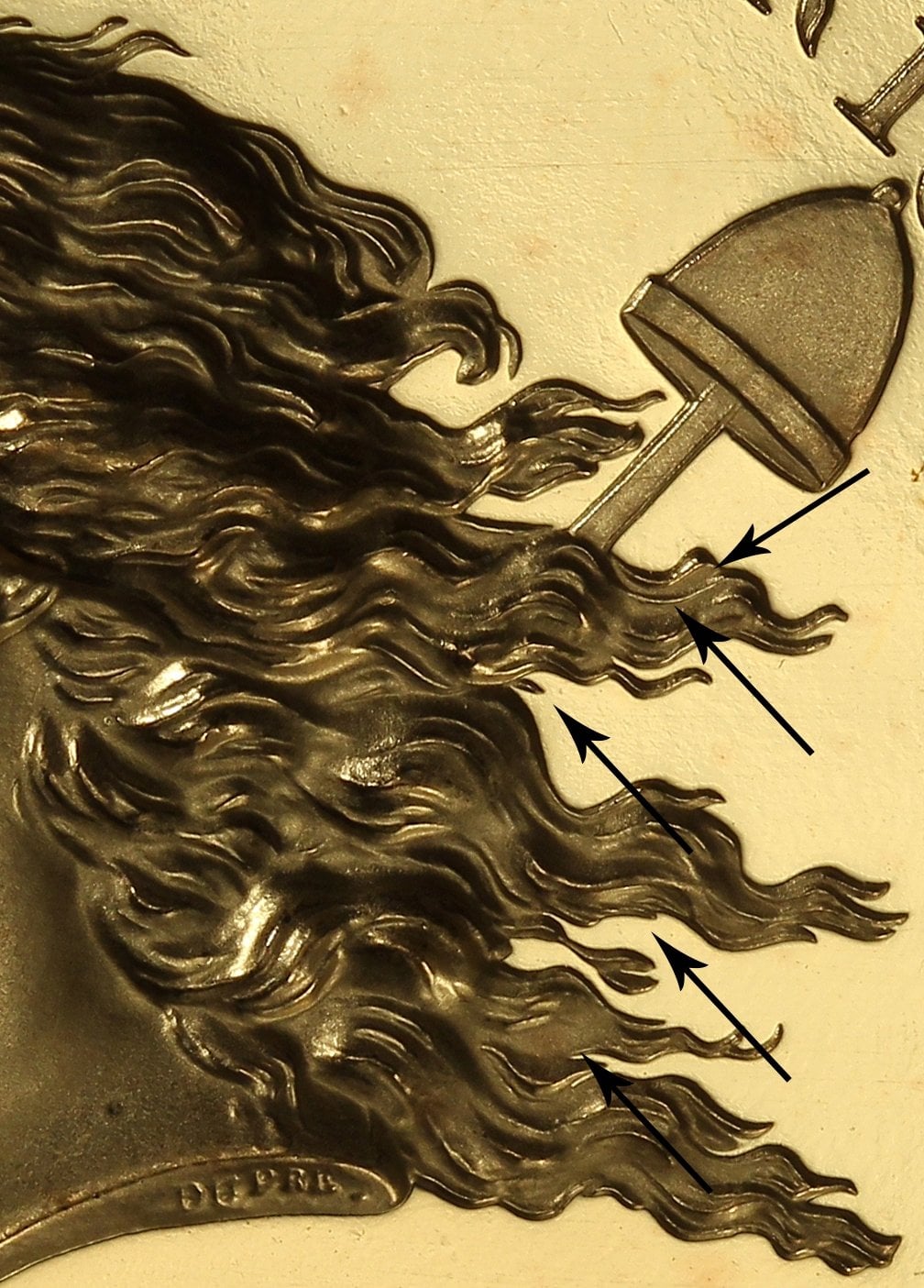
Here's Medal 8 (my Die Pair 4, late die state), showing details that have been polished away and blending into the fields:
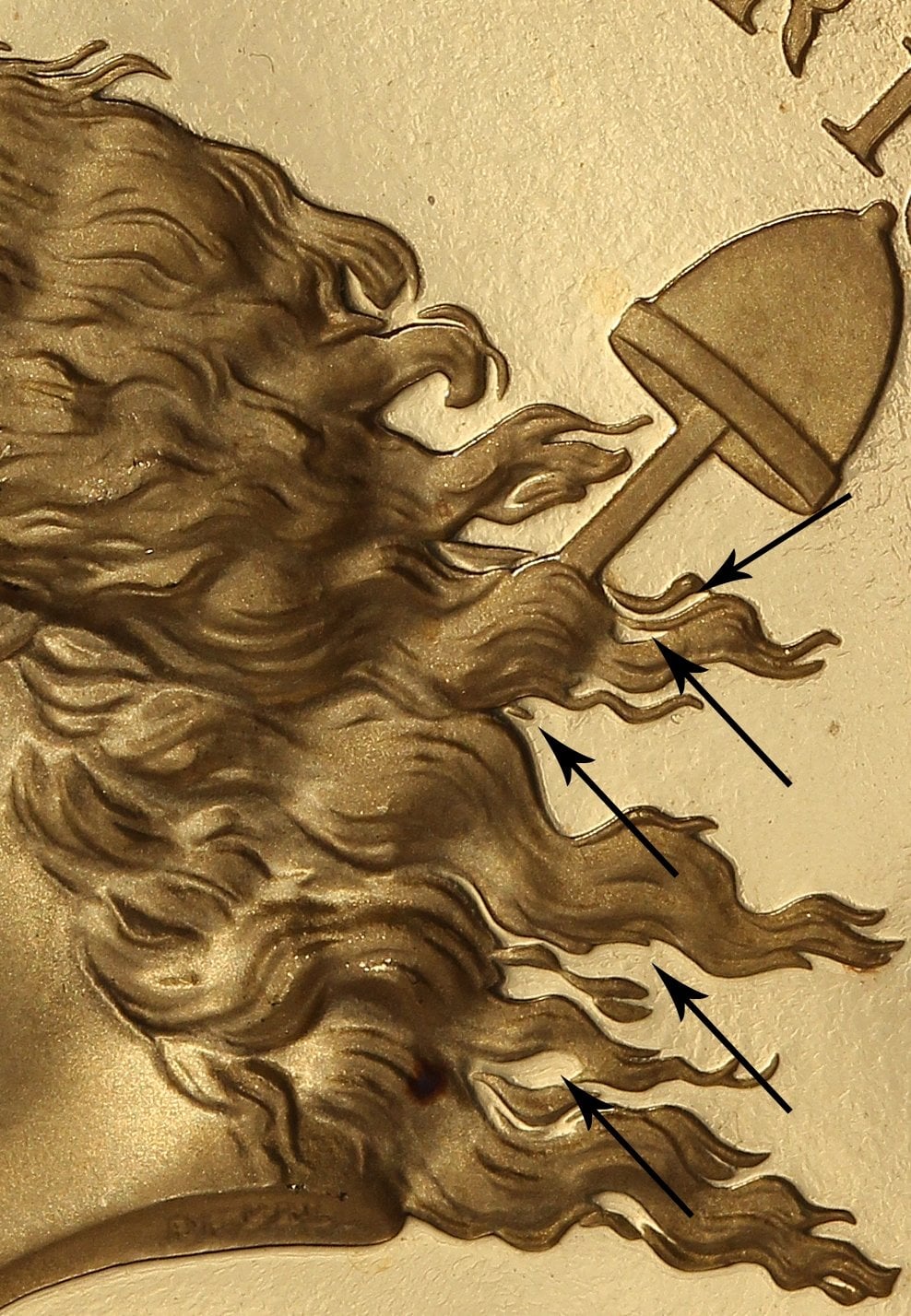
Here's Medal 5 (my Die Pair 3, early die state). Notice how some details seem eroded, but others are more pronounced from Medal 8 above. The areas where details of Medal 8 were polished into the fields, no longer merge into the fields, and the short lock of hair at the 3rd arrow is now longer than those on Medals 7 and 8. Medals 5 and 6 have some minute, but noticeable additional features, as seen at arrow 4, that do not appear on Medals 7 or 8.:
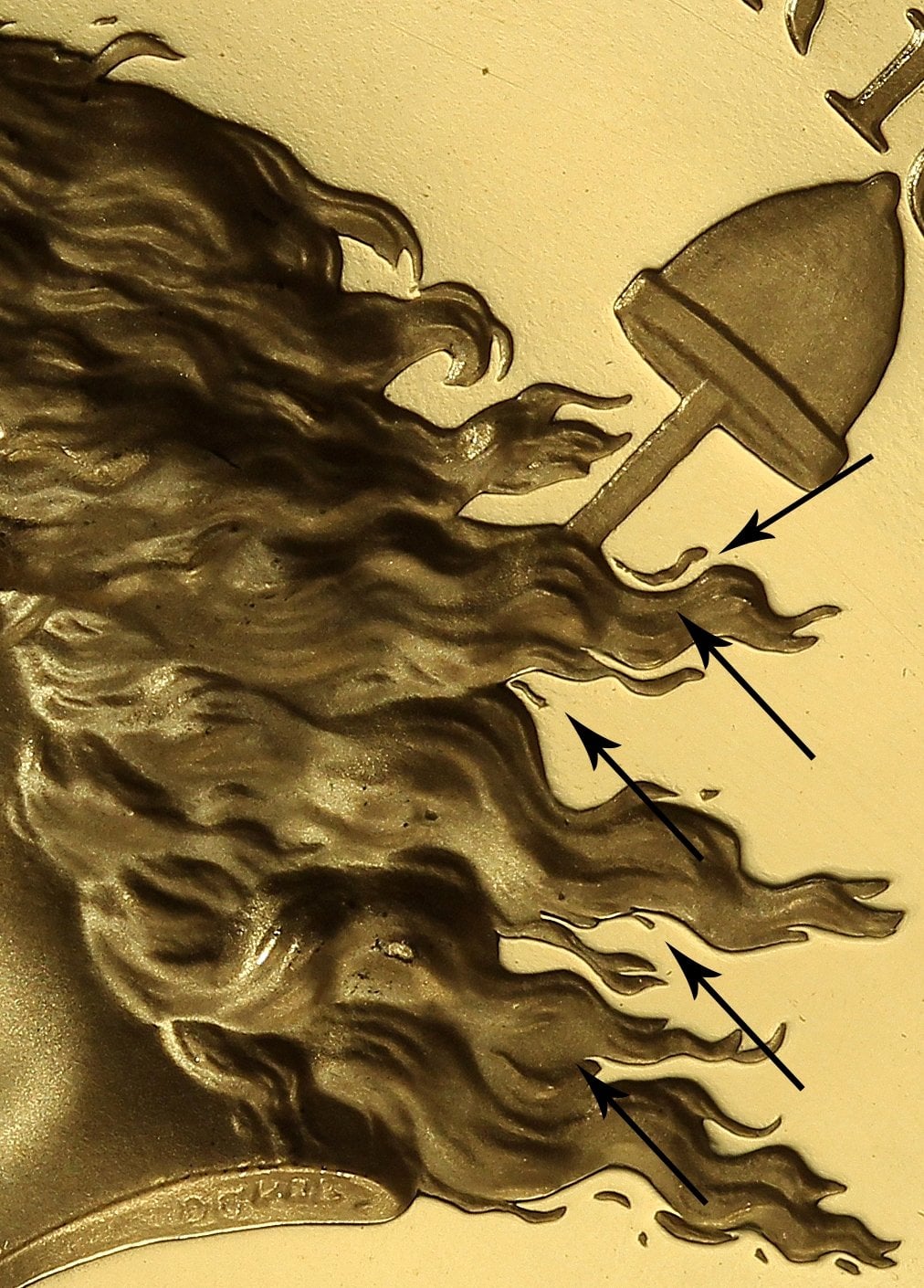
Here's Medal 6 (my Die Pair 3, late die state), showing details that have been polished away:
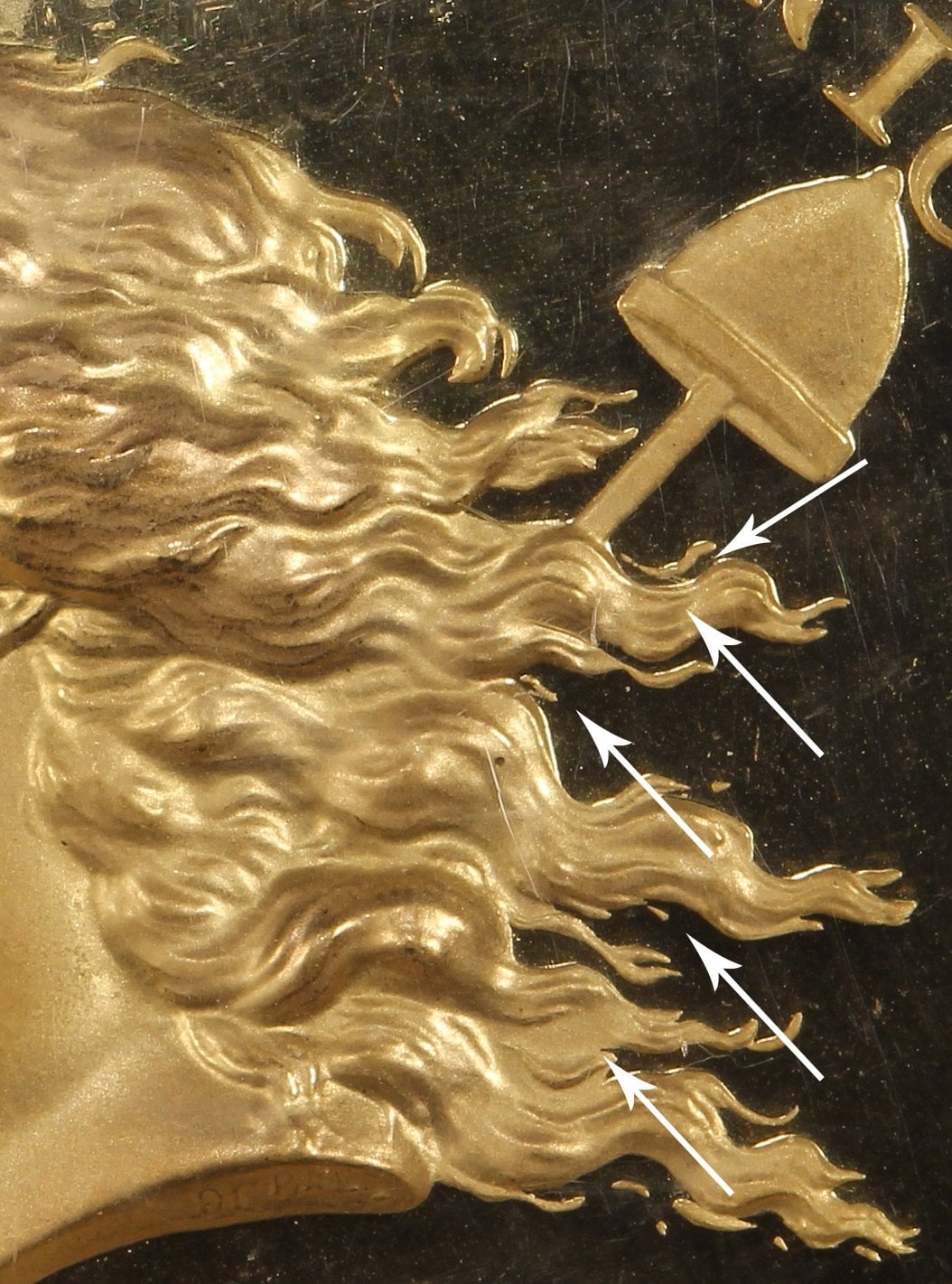
Obviously, the die could have been given extensive reworking at intervals, but I wonder if a Paris Mint employee would actually engrave (or re-engrave) a tip of a lock of hair and have that be disconnected from the rest of Miss Liberty's hair tresses. I also wonder that if what I consider to be Die Pairs 2, 3 and 4 are all the same die, just reworked, would the Paris Mint have numbered the edges of the medals in reverse order of their striking, and then issue signed and numbered Certificates of Authenticity with the medals? (The 8th Medal above is numbered after the 7th, which is numbered after the 6th, which is numbered after the 5th!)
{sigh} time to harvest some disagrees...
I find d carr's insights to be strongly valid here, as I assume he has a coin press or two, and that he has messed with a lot of dies.
I would also think that despite the marketing hype from La Monnaie de Paris, the people working in the atelier would frequently consider their work to be 'just another job' and making small adjustments to the dies and presses is routine (even when working with gold) and something that they don't document or that they are not violating any internal policies. They are simply trying to get the production run completed and get the results to pass inspection. A working stiff has gotta do what he's gotta do.
These are just big hunks of modern gold, borderline 'melt me' stuff (if you don't think so, look at the APMEX 'buy' price), few people are going to own more than one (most people will never own one). Perhaps we should argue whether or not to call these 'restrikes' or 'replicas'.
Minutiae is mildly interesting until it is not. Everybody has their own threshold. Why not write to the Paris Mint with your questions? Being a staid government bureaucracy, probably many of the people who did this work are still employed there.